


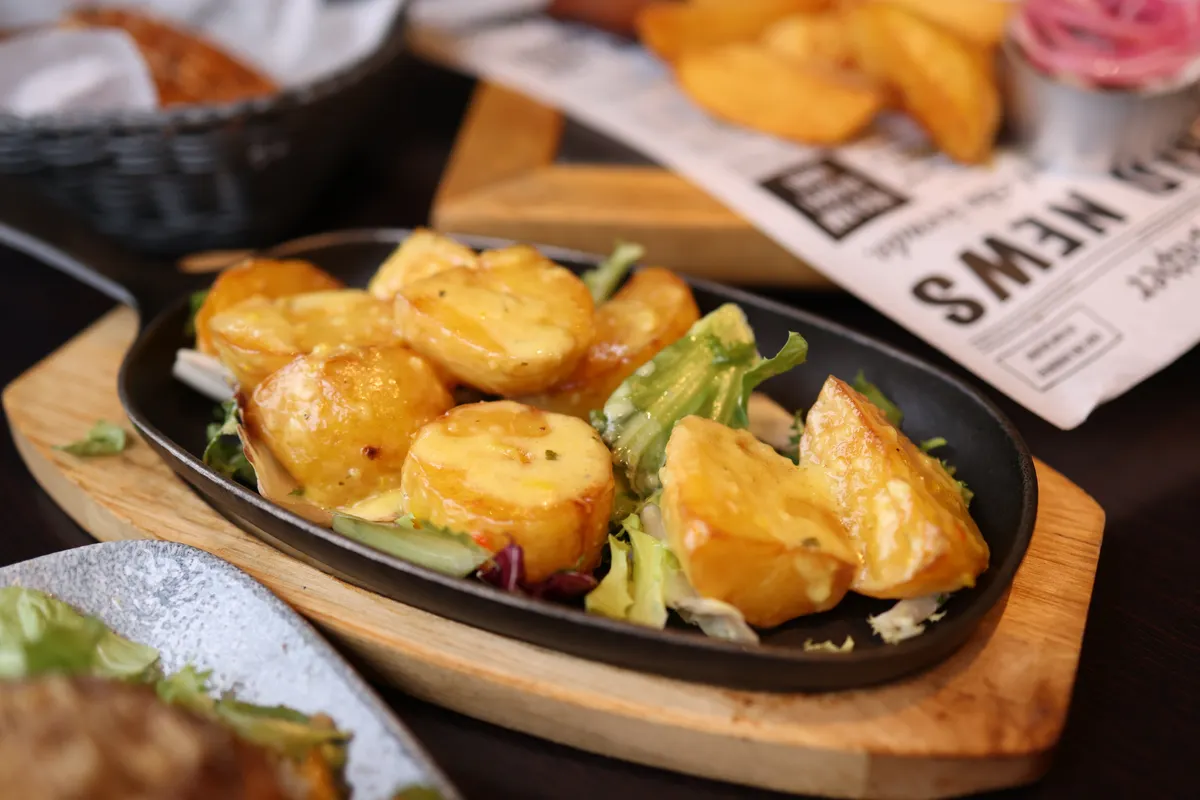
The bloomin baked potato recipe published by Delish solves one of the oldest complaints about jacket potatoes: the absence of genuine crunch. Serving four, it clocks in at 392 calories per serving, with a total time of one hour including 15 minutes of prep.
The recipe was created by Alejandro Valdes Lora and verified by the Delish Test Kitchen, giving it the kind of practical sign-off that separates a tested method from a speculative one. The technique borrows the scored, fan-like structure associated with a bloomin’ onion and applies it to large russet potatoes, each weighing 8 to 10 oz.
The Technique Behind the Bloomin Baked Potato Recipe
The prep work is straightforward but requires a little patience. Each potato is placed cut-side down between two chopsticks or skewers on a cutting board, which act as a physical stop to prevent the blade going all the way through. Slices are made at roughly ¼-inch intervals, then the potato is rotated 90 degrees and the process repeated, creating a crosshatch pattern that fans out during baking.
Cutting a thin slice from one long side of each potato before scoring keeps them stable on the board. Without that step, a round potato on a flat surface is awkward to work with and the cuts become uneven. It is a small adjustment that makes the rest of the process considerably easier.
Once scored, the potatoes are brushed with ¼ cup of extra-virgin olive oil and seasoned with kosher salt, then arranged on a parchment-lined baking sheet. They go into an oven preheated to 425°F and bake for 40 to 50 minutes until the inside is tender and the fanned edges have crisped up. The high heat is what drives the texture: the exposed cut surfaces dehydrate and colour in a way a conventional unscored jacket potato never quite manages.
Cheese, Toppings and the Final Broil
With a minute left to go, the method shifts. The broiler is turned to high, the potatoes are scattered with 1 cup of shredded cheddar, and they go back under for 30 to 60 seconds, just long enough for the cheese to melt without burning. That final burst of direct heat also deepens any colour on the potato’s edges that the oven has not already achieved.
Topping choices are deliberately open. The base suggestion is sour cream, sliced chives and bacon bits, which tracks closely with a traditional loaded baked potato, but the recipe is explicit that this is a canvas. The crosshatch structure means toppings sit in the grooves rather than sliding off, which is a practical advantage over a smooth-skinned potato.
The scored format also gives the dish a visual identity that makes it work as an appetiser rather than purely a side. Bloomin’ onions have long had that dual role in casual dining settings, and the same logic applies here: something that arrives at the table looking unusual tends to generate more interest than a plain jacket.
Russet potatoes are specified for their starchy interior, which becomes fluffy under prolonged heat, and their thick skin, which holds its shape through the baking and broiling process. The ¼-inch scoring interval is close enough to produce a fine, layered fan without the slices becoming fragile and breaking apart before the dish reaches the table.
The full recipe, including the complete ingredient list and step-by-step directions, is available on the Delish website, where the Delish Test Kitchen’s sign-off confirms the method has been tested for reliability before publication.