


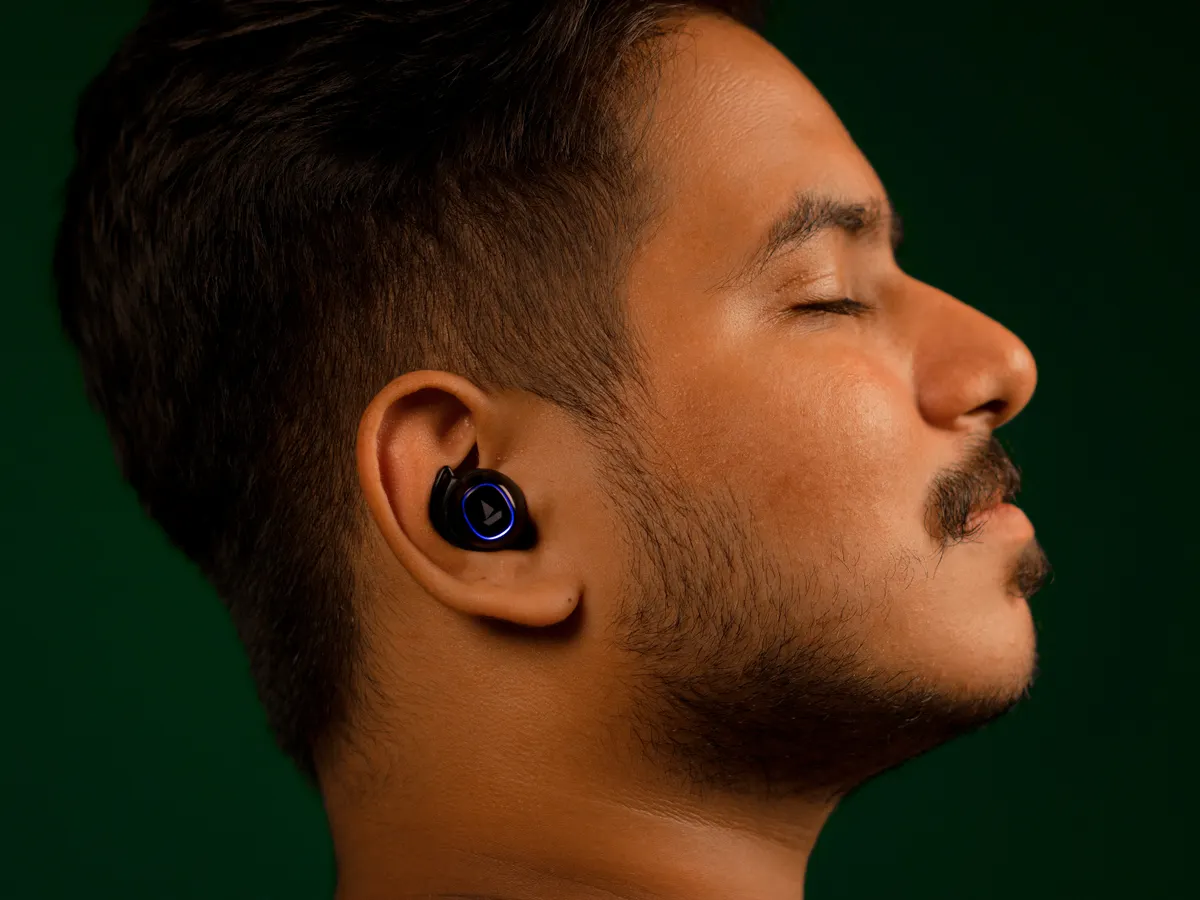
The NextSense Smartbuds sleep review that has been circulating among wearable-tech enthusiasts raises a straightforward question: can a pair of earbuds do more than log your rest? At $299 (down from $349), the Smartbuds use electroencephalography (EEG) to record electrical activity in the brain directly, setting them apart from the photoplethysmography (PPG) light-sensor approach that most consumer sleep trackers rely on.
Caitlin Shure, head of product at NextSense, frames the distinction plainly. ‘As you calm down and eventually fall asleep, your dominant brainwaves literally get slower,’ she says. ‘We are tapping into those brain signals directly, which are also the same kind of signals that are being looked at if you get a sleep study in the lab.’ The hardware behind that claim is more substantial than the compact form factor suggests: the Smartbuds contain six EEG sensors operating at a 1,000 Hz sampling rate, a specification NextSense publishes on its own site.
How the NextSense Smartbuds Sleep Review Unfolded
The practical experience began with a fitting problem. The earbuds ship with several sized attachments, because proper contact between sensor and skin is what gives the EEG signal its integrity. Wearing a size too large on the first night, the accompanying app flagged the issue immediately and suggested a smaller fit by morning. Once the correct size was in place, the data became genuinely instructive: slow-wave counts, total wake episodes and overall sleep efficiency were surfaced each night.
Slow-wave activity is the measure at the heart of what NextSense is selling. These are the deep, low-frequency pulses of electrical activity associated with restoration and cognitive recovery. ‘Everything that you would associate with a really good night of rest,’ Shure says. Many people who feel unrefreshed after a full eight hours may be experiencing a deficit here without ever knowing it, because PPG-based devices do not capture this layer of brain activity at all.
Beyond data collection, the Smartbuds attempt to actively intervene. Once a user falls asleep, the buds deploy a method called slow-wave enhancement, delivering targeted pink noise while the wearer is unconscious to gently nudge brainwave patterns toward more restorative states. ‘This happens when you’re unconscious,’ Shure explains. ‘It’s very subtle, it doesn’t wake you up.’ That claim held up in testing: the intervention is imperceptible, which is rather the point.
Clinical Context and the Real-World Dataset
The technology underpinning these earbuds has been tested in settings well beyond bedroom trials. In a multi-site study covering 1,255 hours of simultaneous recording, NextSense ear-EEG captured 86.4% of focal seizures identified by traditional clinical EEG methods, a result the company references in its published research. That is a different application from sleep enhancement, but it speaks to the hardware’s sensitivity and why the six-sensor, high-sampling-rate specification matters in practice.
According to MD+DI Online, NextSense has collected over 1,000 nights of real-world EEG data across multiple beta cohorts, one of the larger in-ear sleep datasets assembled outside a controlled laboratory setting. Nearly 50% of those beta participants reported having better or much better sleep, along with improved morning recovery. Shure puts it slightly differently in her own account of user feedback: ‘We’re seeing about half of our users reporting improvements in, yes, sleep quality, but also mood and energy. So not just the sleep itself, but the next day benefits that you would hope to see if your sleep is better.’
The comparison Shure draws with existing wearables is pointed. ‘The wearables that have been popular for the past decade have really banked on the fact that your primary use of them is to look at the data… but then it comes back on you to improve your situation.’ Slow-wave enhancement is the Smartbuds’ answer to that passivity: the device attempts to do some of the work rather than only reporting what happened.
Verdict After Extended Testing
For users who already wear a ring-based tracker like the Oura, the Smartbuds add a layer of brain-derived data that cardiovascular sensors simply cannot provide. The insight alone changed habits: giving permission to go to bed earlier, or identifying which evening behaviours corresponded to stronger or weaker slow-wave counts.
Whether the slow-wave enhancement feature can be credited with meaningful improvement over a short test window is genuinely unclear. The data readout, however, is immediate and specific in a way that blood-flow proxies are not. For users who cannot tolerate earbuds during sleep, the device also supports meditation and focus sessions. For those who can, the combination of real-time EEG monitoring and active slow-wave enhancement represents a materially different proposition from anything currently in the mainstream wearable market.
NextSense lists current pricing and availability directly on its site, with the Smartbuds available from $299.